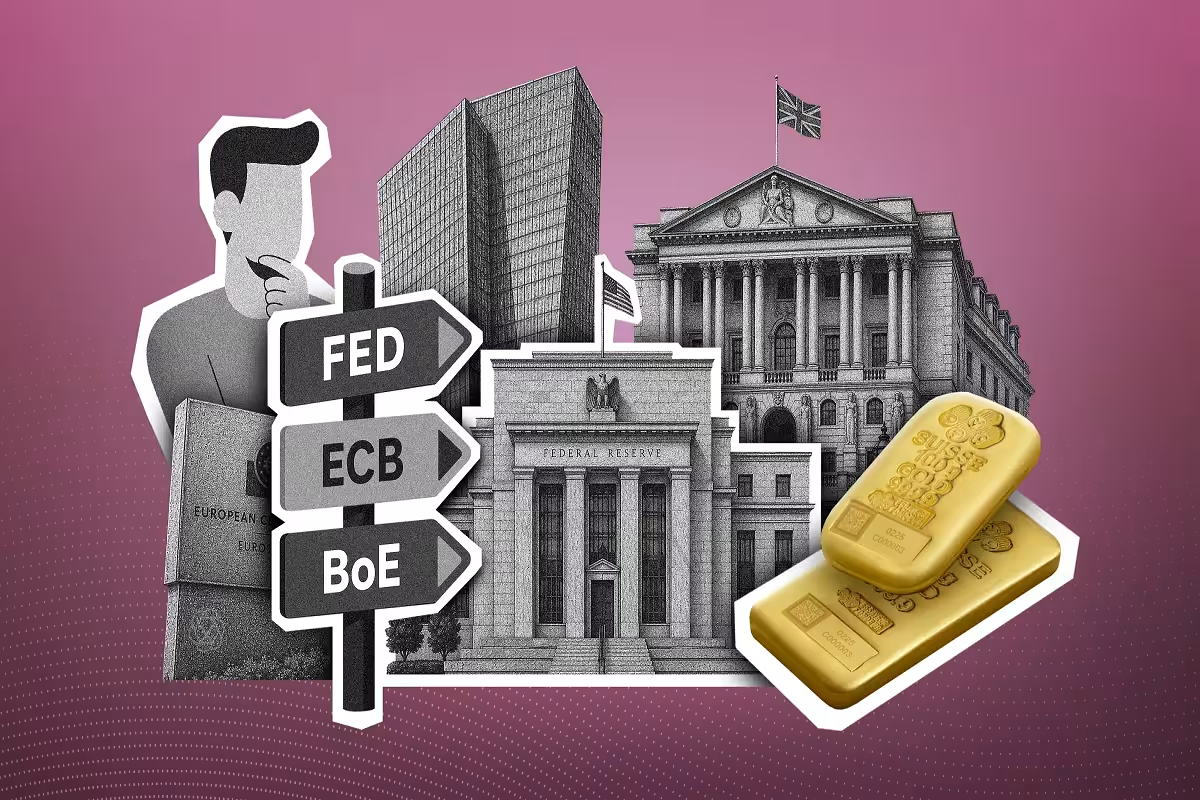
Introduction: The Invisible Puppet Masters of Global Currency Valuation
In the vast ecosystem of foreign exchange trading, retail participants frequently spend countless hours staring at technical charts, drawing trendlines, and attempting to predict price movements based purely on past candles. However, the true directional engine driving every major currency pair is not found on a technical indicator window; it is forged deep within the halls of global central banks. Institutions such as the United States Federal Reserve (Fed), the European Central Bank (ECB), the Bank of England (BoE), and the Bank of Japan (BoJ) hold the ultimate authority over currency valuations through their monetary policies, benchmark interest rate adjustments, and quantitative asset operations.
When a central bank alters its benchmark lending rate or shifts its forward guidance policy, billions of dollars in institutional capital react instantaneously. Understanding how these macro-level decisions translate into daily pip movements is what separates professional currency analysts from struggling retail speculators. This comprehensive masterclass explores the intricate mechanisms behind central bank rate cuts and rate hikes, breaking down how yield differentials, market expectations, and press conferences dictate long-term foreign exchange trends.
1. The Mandates and Policy Tools of Global Central Banks
Before examining how rate shifts impact currency pairs, one must understand why central banks adjust monetary policy in the first place. Almost every major central bank operates under specific statutory mandates, typically revolving around two core economic pillars: price stability (controlling inflation) and maximum sustainable employment. To achieve these goals, monetary authorities utilize a suite of powerful policy tools.
The primary lever used to influence economic velocity. By raising or lowering the cost of overnight borrowing between financial institutions, central banks ripple borrowing costs throughout the entire domestic commercial banking sector, affecting mortgages, corporate loans, and consumer savings yields.
Financial markets rarely wait for an actual rate change to occur; they price in future expectations months in advance. Central bank press conferences, meeting minutes, and speeches by governors serve as crucial communication tools that shape institutional expectations.
When assessing currency strength, traders must remember that exchange rates are fundamentally relative pricing mechanisms. You are never buying or selling a single currency in a vacuum; you are trading the economic outlook of one nation against another.
Reference Matrix: Hawkish vs. Dovish Central Bank Policy Framework
fxone.online research labThe breakdown below contrasts aggressive policy tightening against accommodative easing frameworks and their resulting currency impacts.
2. The Mechanics of Rate Hikes: How Tightening Drives Currency Appreciation
When inflation spikes above target thresholds, central banks respond by implementing rate hikes. A rate hike increases the cost of money across the domestic economy, dampening consumer spending and cooling corporate expansion to bring inflation back under control. For foreign exchange markets, this tightening cycle initiates powerful structural trends.
-
Attracting Global Yield: Institutional funds, pension funds, and foreign investors naturally gravitate toward higher-yielding sovereign debt. When a central bank raises interest rates, domestic bond yields rise, increasing global demand for that nation's currency to purchase those bonds.
-
The Expectation Loop (Rumor vs. Fact): Markets trade on future expectations rather than current announcements. If institutional desks anticipate a rate hike weeks before the meeting, the currency will rally during the anticipation phase. When the actual hike is delivered, the market may experience a classic "sell the news" reaction if the statement is not as hawkish as expected.
-
Hawkish Forward Guidance: A central bank that hikes rates while signaling further tightening ahead creates sustained, multi-month upward trends in currency pairs like EUR/USD or GBP/USD.
Mastering rate hike cycles allows macro swing traders to position themselves alongside institutional capital flows that can persist for quarters or even years.
Visual Masterclass: Trading Central Bank Rate Decisions & FOMC Press Conferences
Watch this detailed visual walkthrough breaking down how institutional desks position capital ahead of high-impact central bank interest rate announcements and press conferences.
3. The Mechanics of Rate Cuts: How Easing Drives Currency Depreciation
Conversely, when economic growth slows down, business investment freezes, or unemployment rises, central banks shift toward monetary easing. By lowering interest rates, the central bank reduces borrowing costs, injecting liquidity into the financial system to stimulate corporate activity and consumer spending.
From a foreign exchange perspective, rate cuts have a dilutive effect on a currency's international appeal:
-
Capital Flight and Yield Seeking: As domestic interest rates drop, sovereign bond yields decline. Global investors holding assets denominated in that currency experience lower returns, prompting them to liquidate their holdings and convert capital into higher-yielding foreign currencies.
-
Aggressive Easing Cycles: When a central bank initiates an aggressive rate-cutting cycle (such as emergency easing during economic contractions), the currency typically enters a sustained secular downtrend against peers whose central banks maintain steady or restrictive policies.
Understanding easing cycles prevents traders from buying currency dips prematurely when macroeconomic fundamentals point toward structural weakness.
Comparative Analysis: Major Central Bank Mandates and Currency Impacts
Review the structural characteristics of the world's most influential central banks and their direct influence on major currency pairs.
| Central Bank | Currency Code | Primary Focus | Typical Market Impact |
|---|---|---|---|
| Federal Reserve (Fed) | USD | Dual Mandate (Employment & 2% Inflation) | Drives global liquidity and all major pairs |
| European Central Bank (ECB) | EUR | Price Stability (2% Inflation target) | High sensitivity to European energy & German data |
| Bank of England (BoE) | GBP | Monetary stability & 2% CPI target | Noted for rapid volatility during policy shifts |
| Bank of Japan (BoJ) | JPY | Sustained economic growth & price stability | Influences carry trades and global risk sentiment |
During an active Federal Open Market Committee (FOMC) rate decision meeting analyzed by the fxone.online research desk, the Federal Reserve delivered a hawkish surprise by maintaining higher rates while upgrading growth forecasts. Prior to the release, retail participants had accumulated heavy short USD positions anticipating immediate rate cuts. When the hawkish statement dropped, a massive liquidity sweep occurred across USD/JPY and EUR/USD. Our desk avoided trading the initial one-minute algorithmic whip-saw, instead waiting for the post-announcement press conference where Chairman Powell confirmed restrictive policy persistence. We executed long entries on USD/JPY following a 15-minute market structure break, capturing a clean 120-pip institutional trend continuation.
4. Risk Management and Execution Strategies for Central Bank Events
Trading around central bank interest rate announcements offers exceptional profit potential, but it also carries severe execution risks if approached carelessly. High-impact news events frequently trigger extreme market volatility, widening spreads and causing severe slippage on stop-loss orders. To protect trading capital during central bank releases, professional desks adhere to four core risk management rules:
-
Avoid Pre-Announcement Gambling: Opening speculative positions seconds before a rate decision is pure gambling. Institutional desks wait for the initial market reaction and press conference clarity before committing capital.
-
Account for Spread Widening: Liquidity providers frequently widen spreads during major central bank announcements. Ensure your stop-loss placement accounts for temporary spread expansion to avoid getting stopped out prematurely by algorithmic noise.
-
Align with Macro Direction: Always trade in the direction of the newly established macroeconomic trend. Fading a powerful central bank rate hike cycle based on a minor technical retracement often leads to substantial losses.
-
Strict Position Sizing (1% Rule): Cap your maximum financial risk per trade at 1% or less of total account equity, ensuring mathematical survival through volatile macroeconomic news cycles.
Frequently Asked Questions
Why does a currency sometimes drop even after a rate hike?
This occurs due to the "buy the rumor, sell the fact" phenomenon. If institutional investors fully priced in a 25-basis-point rate hike weeks in advance, the currency already rallied during the anticipation phase. If the central bank's accompanying statement sounds less aggressive than expected, traders liquidate long positions, causing the currency to drop.
How do interest rate differentials affect long-term currency trends?
Interest rate differentials measure the gap between two central bank benchmark rates. Capital naturally flows toward the currency offering higher yields while borrowing the lower-yielding currency, creating the foundation for multi-year carry trades and secular macro trends.
Summary: Mastering Central Bank Decisions for Forex Success
Central bank interest rate decisions and monetary policies form the absolute backbone of global foreign exchange markets. By understanding the mechanics of rate hikes, rate cuts, and forward guidance, you can move beyond reactive retail chart analysis and align your trading strategies with institutional macroeconomic flows. Combine these fundamental insights with rigorous risk management to navigate high-impact news events with professional precision.
About the Author: FX Research Team, fxone.online
The FX Research Team at fxone.online comprises institutional market analysts, macroeconomic forecasters, and veteran currency traders dedicated to elevating educational standards in retail foreign exchange. Our curriculum cuts through noise, focusing entirely on fundamental catalysts, risk metrics, and structural price mechanics.