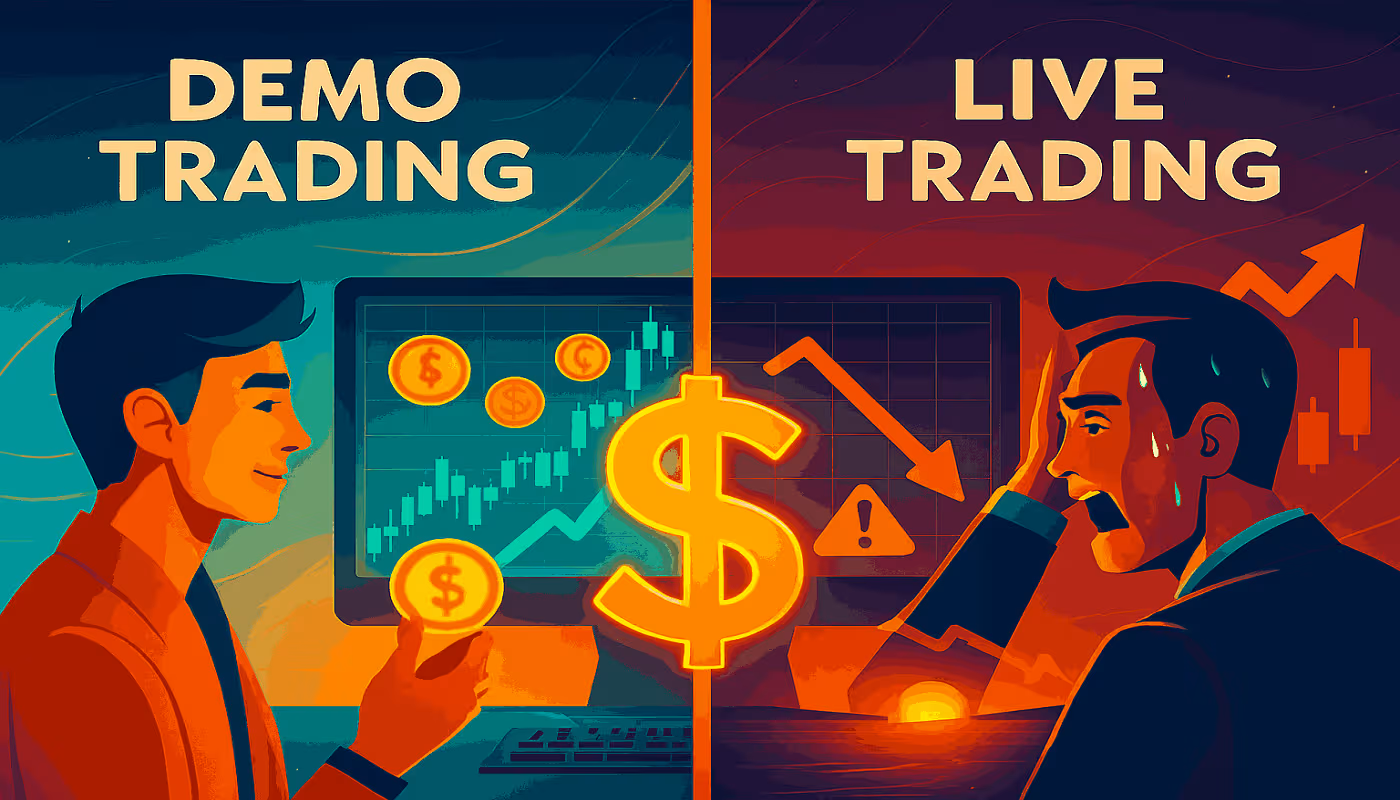
Introduction: The Psychological Chasm Between Paper and Real Capital
Every aspiring retail foreign exchange trader starts their career on a demo simulator. Armed with a fictitious balance of one hundred thousand dollars in digital currency, beginners test out moving averages, RSI divergence strategies, and aggressive lot sizing with complete psychological immunity. When a trade goes against them by fifty pips on a demo account, they simply shrug, watch the virtual equity curve dip, and wait for the market to bounce. There is no biological adrenaline surge, no elevated heart rate, and no threat of losing the funds designated for monthly rent or groceries.
However, the moment a trader deposits real capital into a live brokerage account, the rules of engagement change entirely. The market has not shifted its structural mechanics, but the trader's brain has. Fear and greed take control, transforming calm, rational analysts into impulsive gamblers. Understanding how to bridge this gap safely is the single most important milestone in your trading journey. This comprehensive guide details the mechanical differences between demo and live environments, exposes hidden execution realities, and provides a step-by-step framework to transition your capital without suffering catastrophic drawdowns.
1. Demystifying the Demo Environment: Advantages and Dangerous Traps
Demo accounts are essential educational tools. They allow you to learn platform navigation, test hotkeys, understand order types (market orders, limit orders, stop-losses), and observe how currency pairs move during different trading sessions without risking financial ruin. Yet, relying on demo results as a direct guarantee of live trading profitability is a critical mistake that traps thousands of retail participants.
Simulators provide pristine access to historical charts, technical indicators, and basic order placement mechanics. They allow programmers to test automated Expert Advisors (EAs) and give beginners a sandbox to practice structural chart reading without financial anxiety.
Demo servers lack real liquidity friction. Orders fill instantly at exact requested prices because there is no actual counterparty matching your trade in an live interbank order book. Slippage does not exist, spreads remain artificially tight during news releases, and emotional detachment masks bad risk habits.
When you trade on a demo account with $100,000 in virtual funds, taking a $2,000 loss feels trivial. But if your actual live account balance is $2,000, losing that same percentage on a single poorly managed trade triggers psychological panic. Recognizing this discrepancy is the first step toward institutional maturity.
Reference Blueprint: Demo vs. Live Execution Mechanics
fxone.online research labBelow is a structural comparison showing how order routing, liquidity matching, and emotional pressures differ between paper trading environments and live brokerage setups.
Visualizing the Psychological Shift in Live Markets
Watch this institutional masterclass breaking down how cognitive biases distort decision-making when moving from simulated demo accounts to live capital deployment.
2. The Technical Shock: Understanding Execution Realities
When you finally fund a live account, you will encounter technical market phenomena that demo simulators rarely replicate accurately. Institutional liquidity is finite, and during high-impact macroeconomic data releases (such as NFP or CPI), order books thin out dramatically.
1. Order Slippage
Slippage occurs when your stop-loss or market order executes at a different price than requested due to rapid market momentum or a lack of available liquidity at your target level. On a demo account, your stop loss triggers precisely at 1.0850. In a live account during volatile sessions, that same order might execute at 1.0842, adding 8 pips of unexpected loss to your trade.
2. Spread Widening
The difference between the bid and ask price is your spread. While major pairs like EUR/USD often maintain tight 0.1 to 0.6 pip spreads on demo platforms, live spreads widen significantly during the rollover hour (5 PM New York time) or right during major news prints, directly eating into your floating profit margins.
3. Broker Execution Models (Dealing Desk vs. ECN)
Choosing a reputable broker is paramount. Market Maker (Dealing Desk) brokers take the opposing side of your trade, which can sometimes create conflicts of interest during high volatility. ECN (Electronic Communication Network) brokers route your orders directly to tier-1 liquidity providers, ensuring transparent pricing with raw market spreads and a small commission fee.
3. The Emotional Lifecycle: Navigating Live Account Trauma
Transitioning to live trading is not just a technical hurdle; it is an intense psychological test. Most traders pass through four distinct emotional phases during their first six months with real capital. Recognizing these phases helps you prevent emotional decision-making.
Winning your first few live trades builds overconfidence. You feel invincible, believing your strategy is infallible. This leads traders to prematurely increase their position size, ignoring risk parameters.
A normal losing streak hits. Instead of accepting small 1% losses, fear takes over. You widen your stop-loss, hoping price will reverse, turning a manageable loss into a devastating account blow.
Desperate to recover lost funds, you over-leverage and take low-probability setups outside your trading plan. This compounds your losses and accelerates capital depletion.
You finally embrace the mathematical reality of trading probabilities. You accept losses as a normal business expense, strictly adhere to risk rules, and treat trading like a professional enterprise.
Demo vs. Live Account Performance Comparison Matrix
Review how key operational metrics shift when moving from a simulated demo account to a live-funded brokerage environment.
| Evaluation Metric | Demo Simulator | Live Micro Account | Live Standard Account |
|---|---|---|---|
| Capital Risk | None ($100k Virtual) | Minimal ($100 - $500 Real) | Substantial ($5,000+ Real) |
| Emotional Attachment | Zero (Indifferent) | Moderate (Manageable stress) | High (Potential fear & greed) |
| Execution Slippage | None (Instant Fill) | Low to Moderate | High during volatility / news |
| Position Sizing Test | Irrelevant (Massive lots) | Micro-lots (0.01 units) | Standard lots (1.0+ units) |
4. The Step-by-Step Framework for a Safe Transition
Do not jump straight from a $100,000 demo account into a $10,000 live account overnight. Successful professional traders use a phased transition protocol to protect their mental capital and adjust to real-world execution friction smoothly.
Deposit a nominal amount you are completely comfortable losing (e.g., $100 to $200). Trade only micro-lots (0.01 size). This forces your brain to acknowledge real money while keeping financial risk near zero.
Do not scale up your capital until you achieve 3 consecutive months of profitable, disciplined execution on your micro account while strictly risking no more than 1% per trade.
Incrementally increase your live account deposit only when your psychological discipline matches your mathematical edge. Never fund an account with money needed for essential living expenses.
During our research desk operations at fxone.online, we monitored a cohort of student traders transitioning to live markets. Those who jumped straight from demo to a $10,000 live account blew their balances within three weeks due to oversized position entry and panic-driven stop adjustments. Conversely, students who deposited exactly $500 and traded 0.01 micro-lots experienced the emotional shock in a controlled environment. By treating the $500 account like a $50,000 account, they built unshakeable emotional discipline, allowing them to scale their capital successfully over the long term.
5. Common Pitfalls When Moving to Live Trading
Even with a solid plan, transitioning traders frequently fall into behavioral traps that sabotage their accounts. Avoid these critical mistakes:
-
Risking Rent or Emergency Funds: Depositing money you cannot afford to lose. Financial desperation destroys trading psychology and guarantees emotional failure.
-
Moving Stop-Losses Out of Hope: Widening or removing your stop loss when price approaches your invalidation level because you cannot bear to take a real financial loss.
-
Over-Leveraging Small Accounts: Using 1:500 leverage on a $200 account, ensuring that a single 20-pip adverse price move completely liquidates your balance.
Summary: Mastering the Mindset for Long-Term Survival
Transitioning from demo to live trading is the ultimate test of character for any foreign exchange trader. While demo accounts teach you chart patterns and platform mechanics, live accounts teach you emotional control, risk management, and psychological endurance. By respecting execution slippage, starting with micro-funded accounts, and capping your risk strictly at 1% per trade, you can navigate this critical transition safely and build a sustainable career in global markets.
About the Author: FX Research Team, fxone.online
The FX Research Team at fxone.online comprises institutional market analysts, macroeconomic forecasters, and veteran currency traders dedicated to elevating educational standards in retail foreign exchange. Our curriculum cuts through noise, focusing entirely on fundamental catalysts, risk metrics, and structural price mechanics.