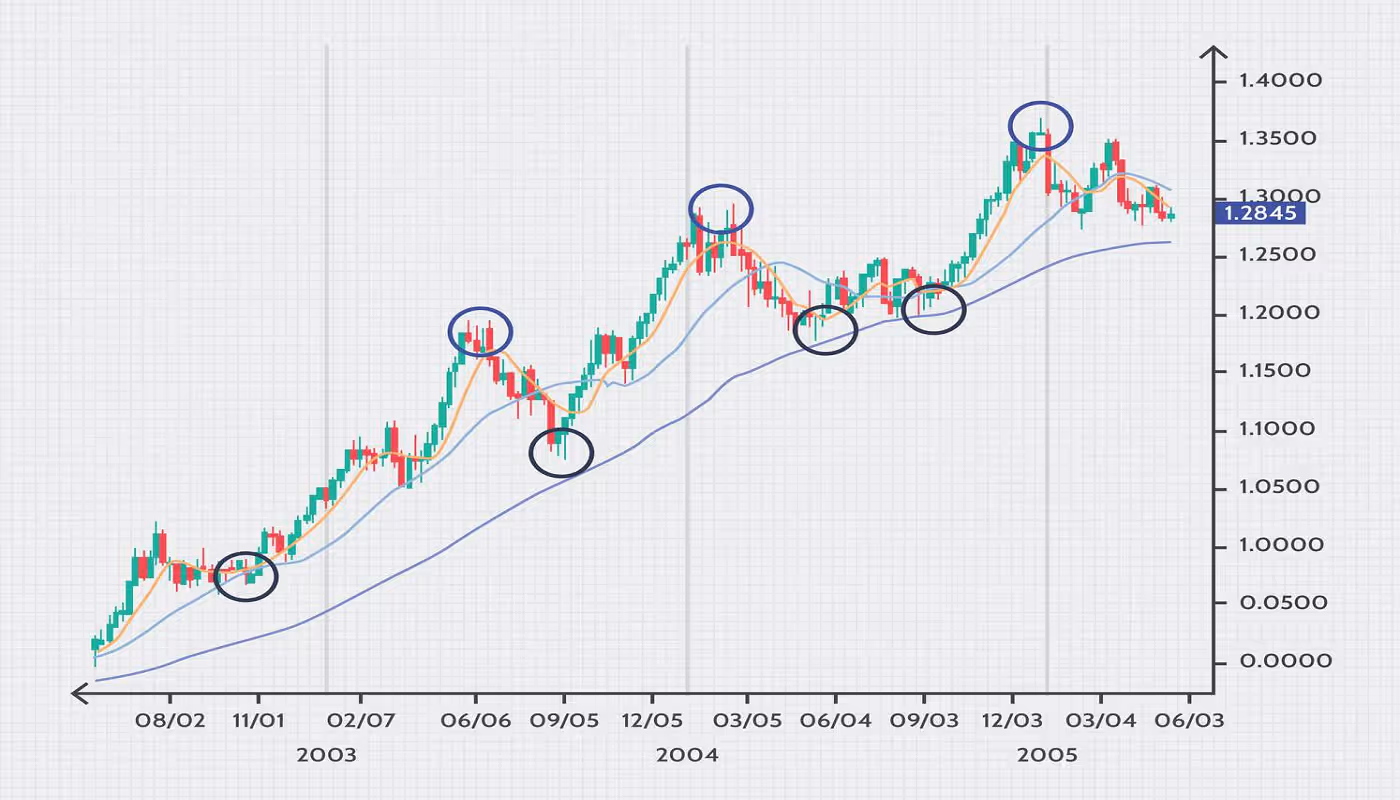
Introduction: Understanding the Building Blocks of FX
To trade the foreign exchange market successfully, you must first master its fundamental grammar. Unlike stock markets, where you buy fractional ownership of a single corporate entity, the foreign exchange market trades in relative values. You are never simply buying or selling one currency in isolation; you are executing an exchange of value between two sovereign economies. Every trade represents a simultaneous bet: that one currency will strengthen while the counter currency weakens.
In institutional and retail environments alike, currency instruments are divided into three distinct structural tiers: Majors, Minors (Crosses), and Exotics. Recognizing the structural makeup, liquidity profiles, spread variations, and session volatility windows of each tier is the difference between navigating the market with surgical precision and getting systematically squeezed by hidden execution costs and slippage.
1. The Core Mechanics: Base vs. Quote Currency
Every currency pair is written with a six-letter ticker divided into two halves separated by a slash (e.g., EUR/USD) or displayed continuously (EURUSD). Understanding how these components interact is vital for accurate position sizing, pip value calculation, and understanding profit or loss calculations.
The base currency is always listed first. It represents the asset you are buying or selling. When you execute a "Buy" order on EUR/USD, you are buying 1 unit of the base currency (Euro) while simultaneously selling the quote currency. The price displayed on your terminal tells you how many units of the quote currency are required to purchase one single unit of the base currency.
The quote currency (also called the counter currency) is listed second. It serves as the pricing metric. If EUR/USD is trading at 1.0850, it means it costs 1.0850 U.S. Dollars to buy 1 Euro. If you short (sell) EUR/USD, you expect the Euro to drop in value relative to the U.S. Dollar, allowing you to buy it back cheaper later.
Consider a real-world macroeconomic parallel: importing goods. If a European manufacturer needs machinery from the United States, they must convert Euros into U.S. Dollars. Institutional participants carry out these massive multi-billion-dollar liquidity transfers daily, dictating the underlying structural momentum of these pairs.
Visualizing Order Execution and Currency Pair Mechanics
Watch this breakdown demonstration showing how liquidity providers route orders for major, minor, and exotic currency pairs through Electronic Communication Networks (ECNs).
2. Tier 1: The Major Currency Pairs
Major currency pairs are the heavyweights of the global financial architecture. By definition, a major pair consists of any globally traded currency paired directly against the United States Dollar (USD). Because the U.S. Dollar is the world's primary reserve currency and features in over 88% of all foreign exchange transactions, these pairs boast immense daily volume and tightest spreads.
The Core Basket of Seven Majors:
- EUR/USD Euro / U.S. Dollar (The Fiber)
- GBP/USD British Pound / U.S. Dollar (Cable)
- USD/JPY U.S. Dollar / Japanese Yen (Ninja)
- USD/CHF U.S. Dollar / Swiss Franc (Swissy)
- AUD/USD Australian Dollar / U.S. Dollar (Aussie)
- USD/CAD U.S. Dollar / Canadian Dollar (Loonie)
- NZD/USD New Zealand Dollar / U.S. Dollar (Kiwi)
Trading Characteristics of Majors: Majors are ideal for retail and institutional intraday traders because their liquidity absorbs large capital allocations with minimal execution slippage. Spreads during peak London and New York trading sessions often compress to fractions of a pip (0.1 to 0.4 pips on ECN accounts). Furthermore, technical analysis patterns—such as support/resistance levels, order blocks, and fair value gaps—tend to perform with higher reliability on majors due to deep market participation and balanced order books.
3. Tier 2: The Minor Currency Pairs (Crosses)
Minor currency pairs—frequently referred to as Crosses or cross-currency pairs—are currency pairs that do not include the U.S. Dollar. Historically, traders had to convert their local currency into USD first before purchasing another asset. Cross pairs emerged to bypass this double conversion friction.
The most actively traded crosses involve the world's other major central bank economies: the Euro, the British Pound, and the Japanese Yen. Examples include EUR/GBP, EUR/JPY, GBP/JPY, and AUD/NZD.
Why Trade Minors?
Minors provide unique opportunities for advanced swing and trend traders. Because they do not feature the U.S. Dollar, they often exhibit distinct macroeconomic dynamics driven by regional trade relationships—such as European economic integration or Australia-New Zealand commodity ties. For instance, GBP/JPY (affectionately known by desks as "The Beast") is legendary for its massive daily average true range (ATR), offering explosive breakout potential for traders who understand volatility management and wider stop parameters.
4. Tier 3: Exotic Currency Pairs
Exotic currency pairs consist of one major global currency paired with the currency of an emerging or developing economy. Examples include USD/MXN (U.S. Dollar / Mexican Peso), USD/TRY (U.S. Dollar / Turkish Lira), EUR/ZAR (Euro / South African Rand), and USD/SGD (U.S. Dollar / Singapore Dollar).
Exotic pairs are governed by localized economic conditions, political shifts, commodity exposures, and capital controls enforced by emerging market central banks. While they can present massive interest rate differentials (fueling high-yield carry trades), they come with structural hazards that can devastate uneducated retail accounts.
High Transaction Costs
Spreads on exotic pairs are significantly wider due to limited counterparty liquidity. Brokers must absorb higher hedging risks, which are passed directly to the trader via wide spreads and swap charges.
Gap Risk & Volatility Shocks
Emerging economies are prone to sudden political interventions, central bank emergency rate hikes, or capital flight, resulting in severe overnight price gaps that bypass standard stop-loss orders.
Comprehensive Analytical Comparison Matrix
Review the structural differences across all three currency classifications to determine which asset class aligns with your trading methodology and capital rules.
| Classification | Example Pairs | Liquidity Depth | Average Spread Cost | Primary Volatility Drivers |
|---|---|---|---|---|
| Majors | EUR/USD, USD/JPY | Extremely High ($Trillions) | Ultra-Tight (0.1 - 0.8 pips) | Fed/ECB policy, NFP, US CPI |
| Minors (Crosses) | EUR/GBP, GBP/JPY | Moderate to High | Moderate (1.2 - 3.5 pips) | Cross-border trade flows, BOE/ECB/BOJ sentiment |
| Exotics | USD/MXN, USD/TRY | Low to Moderate | Wide (15 - 100+ pips) | Emerging market central banks, commodity cycles, political risk |
5. Liquidity Sessions and Pair Selection
Anatomy extends beyond ticker structure—it encompasses time. A currency pair's behavior changes dramatically depending on which global financial center is open.
-
The London Session: Dominates European currency pairs (EUR crosses, GBP crosses). Liquidity is peak, and false breakouts are frequently tested.
-
The New York Session Overlap: The London-New York overlap (8:00 AM to 12:00 PM EST) sees the highest daily volume for all Major pairs, offering tightest execution spreads.
-
The Asian Session: Characterized by tighter ranges for majors, but serves as the prime catalyst window for Japanese Yen pairs (USD/JPY, AUD/JPY) and exotic crosses.
Summary: Choosing Your Focus
Mastering currency pair anatomy prevents costly mistakes. If you are starting out or scaling algorithmic strategies, focus on Major pairs during high-volume sessions to minimize transaction overhead. Once you have built consistency in reading market structure, liquidity sweeps, and price action, expand into Minor crosses for broader trend setups. Approach Exotics with extreme caution, reserving them only for specialized macro setups backed by robust margin buffers.
About the Author: FX Research Team, fxone.online
The FX Research Team at fxone.online comprises institutional market analysts, algorithmic execution specialists, and veteran macro traders dedicated to raising educational standards in retail foreign exchange. Our curriculum cuts through noise, focusing entirely on institutional order flow, risk metrics, and structural price mechanics.