Introduction: Moving from Discretionary Gambling to Institutional Engineering
In the ultra-competitive domain of global currency markets, trading without a comprehensive, rules-based operational plan is mathematically equivalent to navigating an unlit ocean liner through a hurricane without a compass. Retail statistics consistently reveal that over seventy percent of independent market participants burn their venture capital within the first several months of live execution. This systemic failure rarely stems from a lack of intelligence or an inability to identify basic chart formations. Instead, it is the direct consequence of unstructured decision-making, emotional improvisation, and an absence of a codified execution framework.
Institutional trading desks operate under rigid standard operating procedures (SOPs). Every portfolio manager, risk administrator, and execution desk operator is bound by strict constraints that remove personal whim from the equation. This masterclass blueprint provides a comprehensive manual to design, backtest, and implement a professional rules-based forex trading plan. By establishing clear parameters for market selection, technical confluence, risk allocation, and session management, you will replace emotional guesswork with structural consistency.
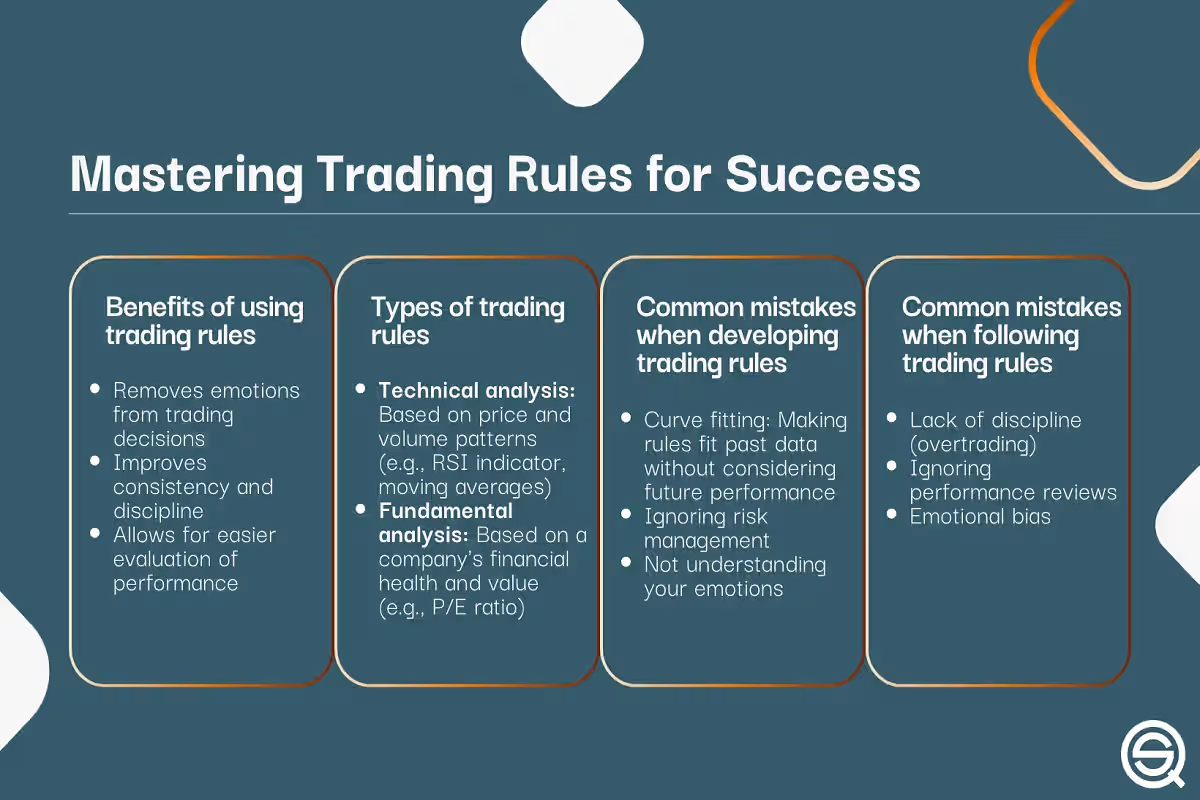
1. The Core Architecture: Deconstructing the Four Pillars of a Master Plan
A truly robust trading plan cannot exist as a vague set of mental guidelines scribbled on a notepad. It must function as an institutional manual divided into four core structural pillars. Each pillar acts as a filter designed to eliminate subjective interpretations when volatility spikes during major macroeconomic news events.
Defining exact asset classes (e.g., Major forex pairs like EUR/USD, GBP/USD) and precise trading windows (e.g., London and New York overlaps) to maximize liquidity and avoid erratic spread widening.
Codifying exact entry triggers, such as higher-timeframe market structure breaks, institutional order block mitigations, and fair value gap imbalances, leaving zero room for mid-session doubt.
Enforcing strict capital preservation rules, including maximum risk caps per trade (e.g., 1% equity) and absolute daily drawdown ceilings to prevent catastrophic account degradation.
Mandatory journaling metrics that log both quantitative data (win/loss ratios, risk-to-reward metrics) and qualitative behavioral parameters (psychological discipline scoring).
When these four pillars operate in seamless alignment, your trading transforms from an exhausting emotional marathon into a systematic business operation.
Operational Framework Matrix: Unstructured Speculation vs. Rules-Based Engineering
fxone.online research labThe comparative breakdown below illustrates the operational divide between reactive retail habits and disciplined institutional structure.
2. Construction Manual: Step-by-Step Guide to Writing Your Personal Plan
Drafting a bespoke trading plan requires radical self-awareness and rigorous backtesting across historical market data. Your plan must reflect your personal schedule, risk tolerance, and psychological strengths.
Follow this sequential implementation checklist to construct your foundational document:
-
Define Your Operational Hours: Explicitly state the exact hours you will sit at your terminal. If you have a full-time career, target specific trading windows such as the London-New York overlap (13:00 to 17:00 UTC) when volume and liquidity peak.
-
Codify Your Technical Edge: Write down your exact entry recipe. For example: "I will only buy USD/JPY when the daily trend is bullish, price has swept previous session lows into a 4-hour order block, and a 15-minute market structure shift occurs."
-
Establish Mathematical Stop and Target Rules: Never calculate stop-losses manually on the fly. Mandate that stop-losses must sit strictly beyond structural invalidation levels, with minimum risk-to-reward ratios set at 1:2 or higher.
-
Incorporate Hard Circuit Breakers: Program your rules to include an automatic shutdown clause. If two consecutive stop losses are hit in a single session, or if a 3% daily drawdown is reached, close all charts immediately.
Having your plan written down in black and white creates psychological friction against impulsive, undisciplined market entries.
Visual Masterclass: Engineering a Rules-Based Trading Framework
Watch this detailed analytical presentation examining how professional currency traders structure their operational plans, execute high-probability strategies, and maintain rigorous risk compliance.
3. Statistical Validation: Backtesting Your Rules Before Risking Capital
A trading plan is merely a hypothesis until it has been rigorously tested against historical market data. Too many retail traders formulate a strategy on Sunday night and risk live capital on Monday morning without knowing its statistical expectancy.
Institutional funds require a minimum sample size of 100 simulated trades before approving any execution strategy. To properly backtest your rules-based plan, execute the following protocol:
-
Sample Size Collection: Scroll back through at least 12 to 24 months of historical price data across your chosen currency pairs on TradingView or professional backtesting software.
-
Expectancy Calculation: Record every winning and losing trade based strictly on your written rules. Calculate your mathematical expectancy using the standard institutional formula: $\text{Expectancy} = (\text{Win Probability} \times \text{Average Win}) - (\text{Loss Probability} \times \text{Average Loss})$.
-
Maximum Drawdown Stress Testing: Identify the longest consecutive losing streak in your backtest data. Ensure your account capital and risk percentage can comfortably survive a drawdown of three times that historical streak without reaching margin call levels.
If your backtest data reveals a positive expectancy over 100 samples, you possess a true statistical edge. This empirical confidence prevents you from abandoning your rules during normal market drawdowns.
Comparative Matrix: Emotional Speculator vs. Rules-Based Operator
Review the clear operational distinctions in behavior, execution habits, and account longevity between unstructured speculators and rules-based professionals.
| Evaluation Metric | Emotional Speculator Approach | Rules-Based Professional Protocol | Long-Term Impact on Account |
|---|---|---|---|
| Pre-Market Preparation | Opens charts randomly; hunts for immediate trades out of boredom | Reviews economic calendar and pre-filtered watchlist pairs | Eliminates impulsive low-probability entries |
| Risk Management | Arbitrary lot sizes adjusted based on emotional confidence | Strict fixed percentage risk model (maximum 1% per position) | Guarantees survival through losing streaks |
| Trade Management | Micro-manages open positions; manually closes winners too early | Sets automated stop-losses and take-profit targets; steps away | Maximizes risk-to-reward efficiency |
During a comprehensive institutional mentorship audit performed by the fxone.online research team, we tracked the performance trajectory of two retail traders over a 90-day testing period. Trader David operated without a formal trading plan, entering positions based on momentum candles and varying his lot sizes whenever he felt confident after a winning streak. Predictably, during a volatile range-bound market phase, David experienced severe drawdowns, frequently overriding his stop losses and wiping out 65% of his capital within six weeks. In contrast, trader Elena implemented our rigorous rules-based trading blueprint. Elena restricted her trading exclusively to the London session, waited for 4-hour structural order block mitigations, capped every trade at exactly 1% risk, and enforced a strict two-loss daily circuit breaker. Although Elena experienced a standard 5-trade losing streak during mid-quarter macroeconomic shifts, her fixed risk parameters preserved her capital base. When market conditions shifted back into a clean directional trend, her 1:3 risk-to-reward setups propelled her account to a 28% net profit by the end of the quarter. This case study demonstrates that long-term success in foreign exchange trading belongs entirely to those who substitute emotional intuition with a disciplined, rules-based operational plan.
4. Plan Evolution: Periodic Auditing and Adaptive Refinement
A professional trading plan is not a static document set in stone; it is a living operational manual that evolves alongside market macro-regimes and your own growing analytical skill set. However, evolving a plan must never be confused with mid-session rule-breaking.
-
Quarterly Performance Reviews: Conduct a thorough audit of your trading journal every 90 days. Aggregate your last 100 trades to check if your win rate and risk-to-reward ratios align with your initial backtest data.
-
Isolating Structural Weaknesses: If certain currency pairs or specific days of the week consistently produce negative expectancy in your journal, amend your plan to permanently exclude those assets or sessions from your watchlist.
-
Zero Tolerance for Mid-Session Changes: Never alter your trading plan while a position is open or during an active trading session. All operational adjustments must be tested, written, and integrated during weekends when the global markets are closed.
Treating your trading plan with the same professional reverence as a corporate business plan is the definitive bridge between struggling retail speculation and consistent institutional longevity.
Frequently Asked Questions
What are the absolute must-have components of a forex trading plan?
Every professional trading plan must include precise market session hours, an explicit technical entry/exit recipe, fixed mathematical risk parameters (such as a 1% per trade cap), and mandatory daily circuit breaker rules to prevent emotional over-trading.
How many historical trades should I backtest before trading my plan live?
Institutional desks recommend a minimum sample size of 100 to 200 simulated trades across at least 12 to 24 months of historical price data. This ensures your strategy has survived various market regimes, including trending phases, high volatility news events, and choppy consolidation ranges.
Summary: Securing Long-Term Consistency Through Structural Discipline
Building and adhering to a rules-based forex trading plan is the ultimate differentiator between retail account failure and sustainable institutional success. By codifying your session scope, technical confluences, risk parameters, and audit protocols, you eliminate the emotional volatility that drains capital accounts. True market mastery is not achieved by predicting every individual candlestick, but by executing your tested rules with unwavering consistency over hundreds of trades.
About the Author: FX Research Team, fxone.online
The FX Research Team at fxone.online comprises institutional market analysts, macroeconomic forecasters, and veteran currency traders dedicated to elevating educational standards in retail foreign exchange. Our curriculum cuts through noise, focusing entirely on fundamental catalysts, risk metrics, and structural price mechanics.