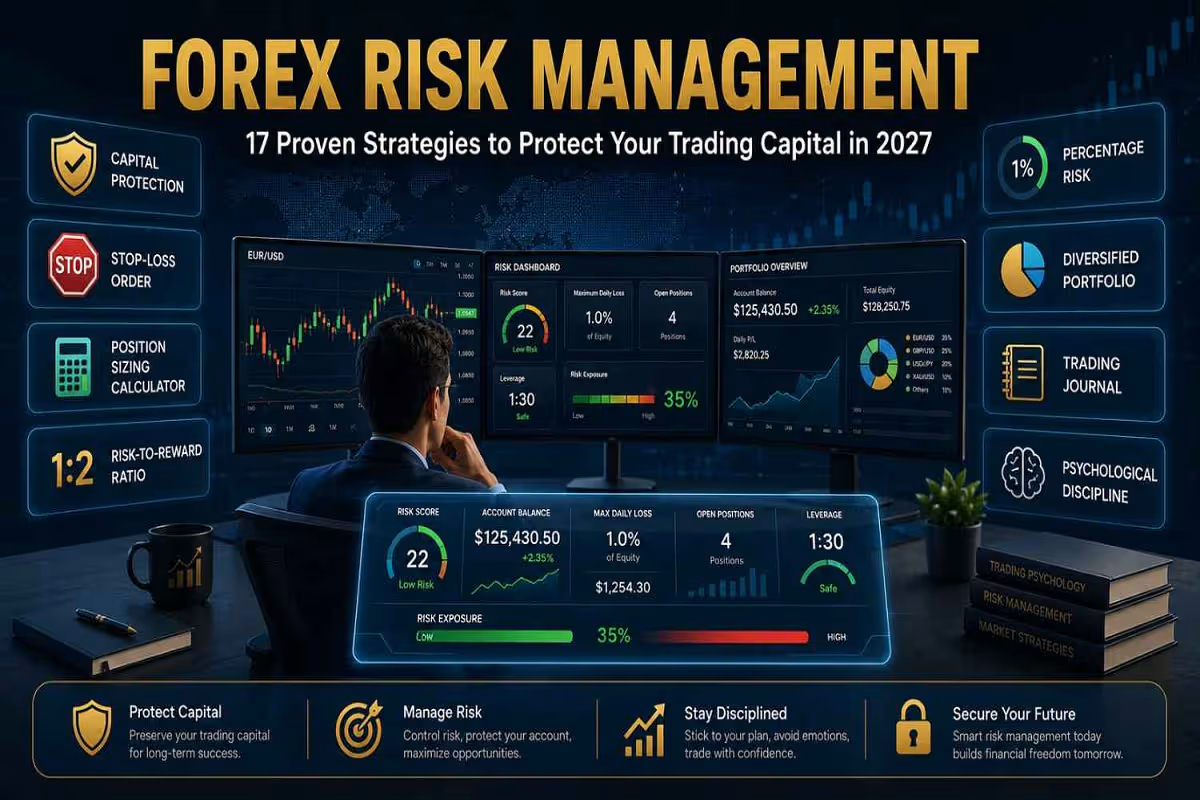
Introduction: The Mathematics of Survival in Foreign Exchange
The foreign exchange market is the most liquid, highly leveraged financial arena on earth. Every single day, over seven trillion dollars change hands across global electronic communication networks. Yet, despite this immense opportunity, industry statistics consistently reveal that a vast majority of retail participants lose their trading capital. Why do so many ambitious traders fail within their first twelve months? The answer rarely lies in a lack of technical chart pattern knowledge or an inability to spot support and resistance levels. Instead, failure is almost universally rooted in poor risk management, emotional position sizing, and a fundamental misunderstanding of mathematical drawdown recovery.
Professional trading desks do not view the markets through the lens of how much money they can make on a single winning trade; their primary operational focus is always on how much capital they stand to lose if the market invalidates their thesis. This institutional risk-first mindset is anchored by strict quantitative boundaries, most notably the legendary 1% Rule. By strictly capping your total risk exposure per transaction to no more than one percent of your active account equity, you create an impenetrable mathematical shield against catastrophic losing streaks. This masterclass deconstructs the structural mechanics of position sizing, the severe asymmetry of drawdown recovery curves, and how implementing institutional risk protocols can transform your trading career from a speculative gamble into a disciplined professional business.
1. The Anatomy of Account Destruction: Why Fixed-Lot and Over-Leveraged Trading Fails
Retail traders frequently enter the forex market with dangerous misconceptions about leverage. Brokers routinely offer leverage ratios of 100:1, 200:1, or even 500:1. To an inexperienced participant, high leverage feels like a superpower—a way to control a massive position value with a minuscule margin deposit. However, professional desks treat leverage as operational ammunition that, if mishandled, will instantly destroy portfolio equity.
Trading the exact same lot size (e.g., standard 1.0 lots) regardless of account balance or stop-loss distance guarantees erratic risk exposure. A 50-pip stop loss requires vastly different capital allocation than a 20-pip stop loss.
Increasing position size after a winning streak (revenge sizing or over-confidence) or doubling down after a loss to make back capital quickly leads directly to a total margin call and account wipeout.
Trading without a mathematically defined stop loss or risking 10% to 20% per trade means a standard four-trade losing streak will permanently cripple your account, requiring superhuman gains just to break even.
Understanding these pitfalls is the first step toward genuine professional maturity. Survival in the forex market is not about hitting a home run on every single trade; it is about staying in the game long enough for your statistical edge to compound over hundreds of executions.
Desk Terminal Matrix: Account Longevity vs. Risk Percentage Model
fxone.online risk labThe simulation below illustrates how consecutive losses impact a $10,000 trading account under varying risk percentage rules.
2. Core Mechanics: Calculating Position Size with Mathematical Precision
The 1% Rule is deceptively simple in concept: no single trade should ever risk more than 1% of your total account equity. If your account balance is $10,000, your maximum allowable financial loss on any single trade—triggered if your stop loss is hit—is exactly $100. However, executing this rule requires precise mathematical calculation factoring in currency pair pip values, account currency denomination, and stop-loss distance in pips.
Professional desks utilize standardized formulas to calculate exact position sizing before executing any market order:
-
Step 1: Determine Maximum Dollar Risk: Multiply your current account balance by 0.01. For a $20,000 account, your risk budget is $200.
-
Step 2: Measure Stop-Loss Distance in Pips: Based on market structure, identify where your technical invalidation level lies (e.g., a 40-pip stop loss on EUR/USD).
-
Step 3: Calculate Pip Value per Standard/Mini/Micro Lot: Determine the monetary value of a single pip for the specific currency pair you are trading.
-
Step 4: Execute Position Sizing Formula: Divide your Maximum Dollar Risk by (Stop-Loss Pips $\times$ Pip Value per Lot) to derive the exact lot size to enter.
By automating this calculation or embedding it into your trading checklist, you eliminate emotional bias from position sizing entirely. Whether you are trading major currency pairs or volatile cross pairs, your risk remains rigorously standardized.
Visual Masterclass: Mastering Position Sizing and Capital Preservation Protocols
Watch this detailed analytical breakdown illustrating how institutional risk managers calculate lot sizes, manage margin utilization, and protect portfolios during high-volatility sessions.
3. The Cruel Asymmetry of Drawdown Recovery
One of the most critical mathematical concepts every currency trader must internalize is that drawdown recovery is strictly non-linear. When an account suffers a percentage loss, the percentage gain required just to return to break-even is significantly higher. This mathematical reality is what destroys reckless traders during extended losing streaks.
Institutional risk models emphasize this asymmetry through strict operational thresholds:
-
Mild Drawdowns (10% Loss): If a $10,000 account drops to $9,000, a modest 11.1% gain is required to recover the lost capital. This is easily achievable with disciplined execution.
-
Severe Drawdowns (50% Loss): If poor risk management causes a 50% account drawdown, reducing equity from $10,000 to $5,000, you do not need a 50% gain to recover—you require a staggering 100% gain just to get back to zero.
-
Catastrophic Drawdowns (75% Loss): A 75% account drop requires an astronomical 300% return just to break even, forcing traders into dangerous over-leveraging that guarantees total ruin.
By strictly adhering to the 1% Rule, even a terrible losing streak of ten consecutive trades results in a manageable drawdown of less than 10%, keeping recovery entirely within normal statistical parameters.
Comparative Matrix: Retail Speculation vs. Institutional Risk Management
Evaluate the operational differences between amateur trading habits and professional institutional risk protocols.
| Operational Metric | Retail Speculator Approach | Institutional Desk Protocol | Impact on Longevity |
|---|---|---|---|
| Position Sizing | Fixed lot sizes or emotional scaling based on gut feeling | Strict mathematical calculation based on 1% equity risk | Prevents catastrophic single-trade exposure |
| Stop Loss Management | Moving stop losses further away or trading without stops | Hard stop placed at structural invalidation level immediately | Eliminates runaway catastrophic losses |
| Drawdown Response | Revenge trading and increasing lot size to recover losses | Mandatory cooling-off period and reduced risk allocation | Preserves capital during choppy market regimes |
During a major Non-Farm Payrolls (NFP) release analyzed by the fxone.online research desk, an unexpected employment divergence caused extreme volatility and wider spreads across USD pairs. While several retail trading accounts utilizing 10% risk per trade suffered severe margin calls due to price slippage past their stop losses, our institutional desk had strictly enforced the 1% risk rule on all open GBP/USD positions. Even though market slippage caused our stop loss to execute 15 pips past our intended technical level, the actual monetary loss incurred was tightly contained to 1.3% of total fund equity. This controlled loss allowed our desk to comfortably resume trading normal market structure the following week without emotional fatigue or capital impairment.
4. Psychological Discipline: Mastering the Mindset of Capital Protection
The greatest challenge in foreign exchange risk management is not mathematical complexity; it is psychological discipline. Human beings are biologically wired to hate losing, which often leads traders to hold onto losing positions in the irrational hope that price will eventually return to break-even. Professional traders treat losses not as personal failures, but as normal operating expenses in a probabilistic business.
-
Accepting Pre-Defined Risk: Before clicking the execute button, you must fully accept that your stop loss might get hit. If the potential loss makes you anxious, your position size is too large.
-
Eliminating Revenge Trading: After taking a stop-loss hit, step away from the trading terminal for at least one hour. Trying to immediately win back lost funds destroys discipline.
-
Treating Trading as a Business: Run your trading account like an institutional enterprise with strict risk budgets, regular performance audits, and documented execution logs.
Mastering these psychological boundaries ensures that your emotional state remains stable regardless of short-term market volatility.
Frequently Asked Questions
Is 1% risk per trade too conservative for small trading accounts?
Not at all. In fact, smaller accounts benefit the most from strict risk control. While starting with a $500 or $1,000 account may feel limiting when risking only $5 to $10 per trade, it ensures your capital survives the learning curve while you master market structure and execution consistency.
Can I risk 2% or 3% per trade if my win rate is high?
Some experienced professional desks scale risk up to 2% during high-conviction market regimes, but exceeding 2% drastically accelerates drawdown exposure during unexpected market shockwaves. Sticking to 1% provides an optimal balance between growth and safety.
Summary: Mastering Capital Protection in Forex
Foreign exchange trading success is entirely dependent on your ability to protect your capital. By strictly implementing the 1% rule, calculating position sizes with mathematical precision, understanding the cruel asymmetry of drawdown curves, and maintaining unwavering psychological discipline, you elevate your trading from speculative gambling to a professional institutional discipline. Protect your equity first, and profitability will follow naturally over time.
About the Author: FX Research Team, fxone.online
The FX Research Team at fxone.online comprises institutional market analysts, macroeconomic forecasters, and veteran currency traders dedicated to elevating educational standards in retail foreign exchange. Our curriculum cuts through noise, focusing entirely on fundamental catalysts, risk metrics, and structural price mechanics.